Wednesday, June 20, 2012

Terra-cotta Warriors and Horses

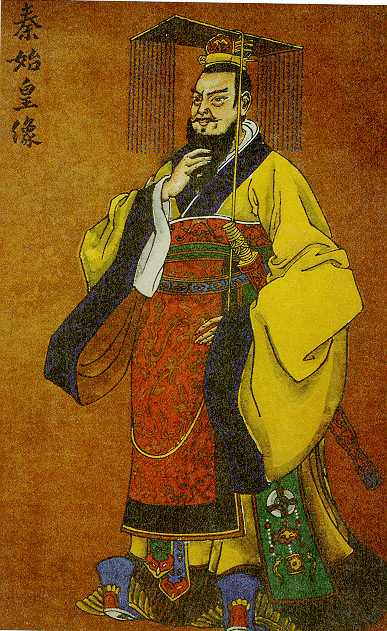
The Terra-cotta Warriors and Horses were sculpted by the Qin Dynasty in 210 B.C. to protect the Emperor Qin Shihuang in his afterlife.  They are regarded as the most important archaeological findings in the 20th century and the eight wonder of the world.  Each warrior has unique facial features with a very realistic technique.  This finding also provided a great display of all kinds of weapons used during the Qin Dynasty.  They discovered the surface of most of the weapons had been treated with chromic oxide to prevent rust.  This is something the American and German armies started using in the 1920's and 30's.  It is amazing to think they had this technology over 2,000 years before it was rediscovered in modern times.  It is estimated that there are more than 130 war chariots, 275 horses, and 7,000 armored warriors.  The sculptures began working on Emperor Qin Shihuang's tomb and the terra-cotta army when he took the throne at the age of 13 and they had not quite finished when he died at 49.  All the workers, architects, and anyone involved in the construction of the tomb were buried alive after the death of the emperor to protect the tomb from being discovered.  

Tuesday, June 19, 2012

Xi'an Market


City Wall of Xi'an


Chinese Dynasties

When we were in Xi'an, we learned that this city of 10 million is the ancient capital of China and home to the 13 early Dynasties of China, including the Qin and Tang. 

The first dynasty united all of China in the year 221 BC.  During the Qin Dynasty, the First Emperor Shi Huangdi standardized the currency, written language, and bureaucratic procedures.  He did this is a very ruthless way, and was known to kill anyone who disagreed with him.  This emperor also began construction of the Great Wall and the Terra Cotta Warriors (see Maria's post coming soon!).  Even though his dynasty only lasted around 20 years, he accomplished a remarkable amount and his changes remained long after he was gone.

The Tang Dynasty (618 - 907) had originally built city walls around Xian. As the cultural, economical, and political center, Xian was a city of strategic military importance.  Therefore, great city walls were constructed to protect Xian.

Later on, during the Ming Dynasty, the City Wall of Xian was built again on the foundation of the earlier  walls, and it took four years, from 1374 to 1378 to rebuild them.  The total perimeter of this wall is 7 miles.  

We were able to bike on the wall and it was beautiful!  it was early in the morning on Sunday, and cars and people were crowding the streets below us.  As we were biking we heard a very loud crowd and pulled our bikes over to see a large outdoor market with lots of fruit, veggies and sundry items.  Our tour guide says that all of the grandmas go to the market every day to get fresh food for lunch and dinner.  It sure sounded like most of the grandmothers in Xi'an were at that market that morning!


Monday, June 18, 2012

Shanghai

We spent the first half of the day traveling.  I am surprised how much our group of American citizens stands out in each city and airport.  In our country, we are used to seeing people of every nationality.  This is not the case here in China.  People watch as we walk by, some try and take our pictures.  We have all found this very amusing but it makes me appreciate the multiculturalism of America and that anyone fits in. 

We have only seen a very small part of Shanghai today but the size of the city and the mass amounts of people is impressive.  Their population is now 20 million.  Shanghai began its rapid growth in the 90's.  Within the last 20 years, the entire city west of the Yangsi River has developed.   This makes up almost half of the city.  They sometimes refer to the new side and the old side.  Shanghai was one of the first Chinese cities to open up to foreign companies.  This had a huge impact on its rapid growth.